By Rohit Chakraborty
What is a Trademark?
A trademark is a distinctive sign or symbol that identifies a particular set of goods or services to its respective proprietor and distinguishes the goods or services of one party from those of others. It may consist of a word, a phrase, a logo, a symbol, a design, an image, or a combination thereof. The primary function of a trademark is to enable consumers to easily identify and choose products or services they trust or prefer.
As per the legal definition given under Section 2(zb) of the Indian Trademarks Act, 1999, a trademark is a distinctive marker that distinguishes products or services from competitors in the market.
A trademark is valid for a period of 10 years from the date of registration, upon expiry of which it may be renewed.
Why register a Trademark?
- Enable consumers to easily identify and choose your products or services.
- Protect your consumers against fake or counterfeit products and unscrupulous services
- An Intellectual Property is a business asset, trademarks being the most basic.
Types of Trademark
Various types of trademark registrations cater to different needs and fulfil varied purposes, all aimed at enabling consumers to recognize products and services associated with specific manufacturers or service providers. The following are the different categories of trademarks recognized worldwide:
- Product Mark: A product mark is applied to goods or products in order to ascertain their origin. They help in preserving a business’s brand value. Typically, applications made under classes 1-34 are classified as product marks as they pertain to tangible commodities.
Example: “Coca-Cola” is a Product Mark which identifies a particular aerated beverage.
- Service Mark: A Service Mark may be used to identify services rather than physical and tangible products. They differentiate between the services provided by one service provider to that of another. Trademark applications made under classes 35-45 are typically regarded as Service Marks.
Example: The name “Visa” is a Service Mark that identifies Visa’s Credit Card Services.
- Collective Mark: A Collective Mark indicates distinctive qualities of goods or services connected to a certain group. It enables people or organisations to jointly defend and represent products and services. The proprietor may be an association, a governmental institution, or a corporation under Section 8.
Example: The device “CA” used by the Institute of Chartered Accountants is a Collective Mark.
- Series Mark: A Series Mark may be employed by a proprietor where they are intending to use multiple marks with an element of similarity. All of these marks may be used in different forms in a series.
Example: McDonald’s products such as McChicken, McCafe, McFloat are all part of the same series mark.
- Certification Mark: A Certification Mark represents information about a product regarding its origin, quality, composition and safety standards, amongst others. It establishes product standards in order to assure consumers that the product meets the quality standards and benchmarks.
Example: The “ISI” device found on most industrial products ascertains that the product meets the quality standards criteria set by the Bureau of Indian Standards.
- Shape Mark: Shape marks are utilized to gain exclusive rights over a distinct shape of a product in order to ensure that consumers can easily identify them as originating from a specific manufacturer. The registration is granted contingent to the shape being deemed as distinctive.
Example: The shape of a Zippo lighter is a shape mark.
- Pattern Mark: Products with distinctive and uniquely designed patterns that act as differentiators are designated with Pattern Marks. In order for these patterns to be eligible for registration, they must be distinctly identifiable.
Example: The Louis Vuitton Checkerboard pattern is a uniquely designed and distinguishable mark.
- Sound Mark: Sound marks are distinctive sounds associated with products or services that are often heard at the beginning or end of commercials. They are commonly known as audio mnemonics and consumers are able to draw a direct connection between the audio and the proprietor.
Example: The Indian Premiere League (IPL) tune is a Sound Mark.
Steps Involvement in the Registration Process
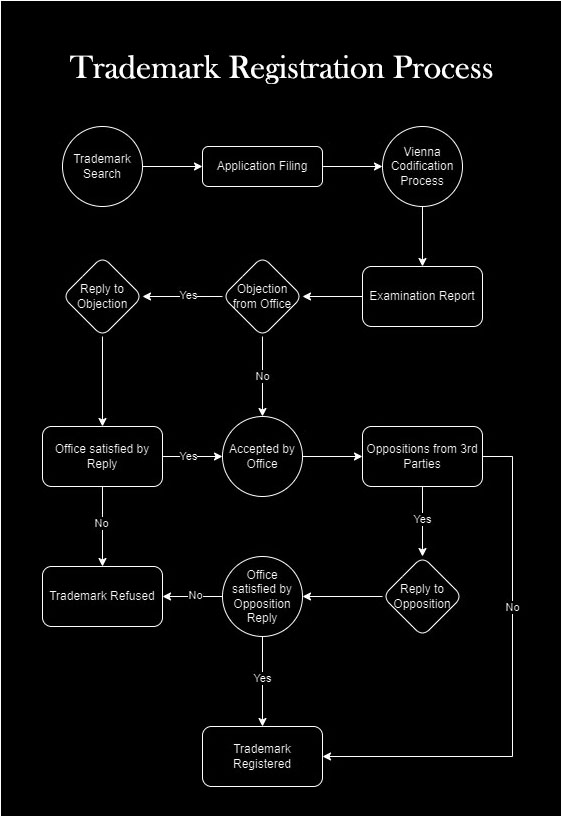
The registration of a trademark follows a lengthy process and may take anywhere between 6 to 12 months for completion. The following illustration offers a brief idea about the steps involved.
Trademark Search
Prior to moving forward with a TM application, it is important to first conduct a comprehensive trademark search in order to ensure the availability of a particular trademark and avoid any conflicts with already existing, registered marks.
Application Filing
Once satisfied with the search results, the next step would be to file an application before the Indian Trademarks Office requesting registration along with all the relevant details. Upon filing of a new application along with the requisite fee, the status “Send to Vienna Codification” is assigned to the trademark.
VIENNA CODIFICATION PROCESS
If the Trademark contains any figurative elements such as a logo, symbol or design, the same is subjected to an examination as per the Vienna Convention. Through this examination, the figurative part of the mark is checked under 29 different categories (Celestial planets, stars, moon, natural events, maps, animals, etc.) in order to ensure non-duplication in the trademark registry.
Upon a successful examination, the registry updates the status to “Formalities Chk Pass”. No further action is needed at this point of time. The status would soon change to “Marked for Exam” once the application has been assigned to a trademark examiner.
In case any clerical errors are found in the application during examination, the status shall change to “Formalities Chk Fail”. In such a case, the application needs to be rectified along with a Government Fee.
EXAMINATION REPORT
Once the formalities are checked, the particulars of the application are now pending examination by the office. Upon completing the examination, the office issues an Examination Report documenting their findings. At this stage, the office may either Accept the application straight away or raise an Objection. The status of the trademark shall accordingly change to either “Accepted” or “Objected”.
In case no objection is raised by the office and the status shows as “Accepted”, no further action would be needed on the part of the applicant. The trademark would be advertised and opened to opposition in due course of time.
However, if an objection is raised by the office and the status is “Objected”, it is important to go through the grounds of objection provided in the Examination Report and provide a point-wise reply to the same within 30 days. Objections are generally raised either under Section 9 or under Section 12 of the Trademarks Act, hence it is pertinent to meticulously understand these provisions of law.
If the office is satisfied by the reply, the application will move forward and the status will now change to “Accepted”. On the other hand, if the office is not convinced by the reply, they may call upon a hearing and provide the applicant with a final chance to make their case.
OPPOSITION PHASE
As the Trademark has now been “Accepted and Advertised”, it is now open to opposition by any third-party. The time period to file an opposition is ordinarily of 3 months and extendable by one additional month.
If no opposition is received during this timeframe, the trademark is now fully registered and has a validity of 10 years.
If one or multiple oppositions are received, the status changes to “Opposed” and the applicant needs to defend their stance against all the oppositions individually through evidence filing, counter-statements and hearings. Upon successful defence against all claims, the trademark may finally be granted registration.
Register your Trademark today!
Navigating the intricacies of trademark registration in India requires careful attention to detail and adherence to legal procedures. By securing robust protection for your trademarks, you safeguard your brand’s reputation and goodwill in the marketplace. As your trusted trademark attorneys, we at Advoke Law are here to guide you through every step of the process, ensuring optimal protection for your intellectual property assets. Advoke Law specializes in Trademark Registrations, Prosecutions as well as Litigation. We also offer other Trademark services such as Trademark Watch and Trademark Due-Diligence. Feel free to contact us to schedule a free consultation!